




The ultimate guide to generative AI for customer service
Learn how generative AI, agentic AI, and agentic RAG technology are transforming CX. Explore use cases, benefits, risks, and best practices.

Customer service has undergone one of the fastest transformations in decades. What started as simple rule-based chatbots has evolved into independent generative AI assistants.
We’ve seen the rise of agentic AI, intelligent systems that understand goals, make decisions, orchestrate workflows, and collaborate with humans to deliver end-to-end support. Agentic RAG was also introduced as a safeguard for AI agents to provide verified and up-to-date information.
Customer expectations have changed with the development of generative AI, they now expect:
- Instant, accurate answers
- 24/7 availability
- Personalized, relevant assistance
- Consistent experiences across channels
Meanwhile, companies need to reduce operational costs, scale globally, and maintain high quality. AI is no longer a “nice-to-have”; it’s the foundation of modern customer experience.
This guide breaks down how generative AI is reshaping customer service in 2025, what’s changed since the early GenAI hype cycles, new risks to manage, and how to deploy AI that is safe, reliable, multilingual, and customer centric.
Understanding generative AI, agentic AI, and agentic RAG
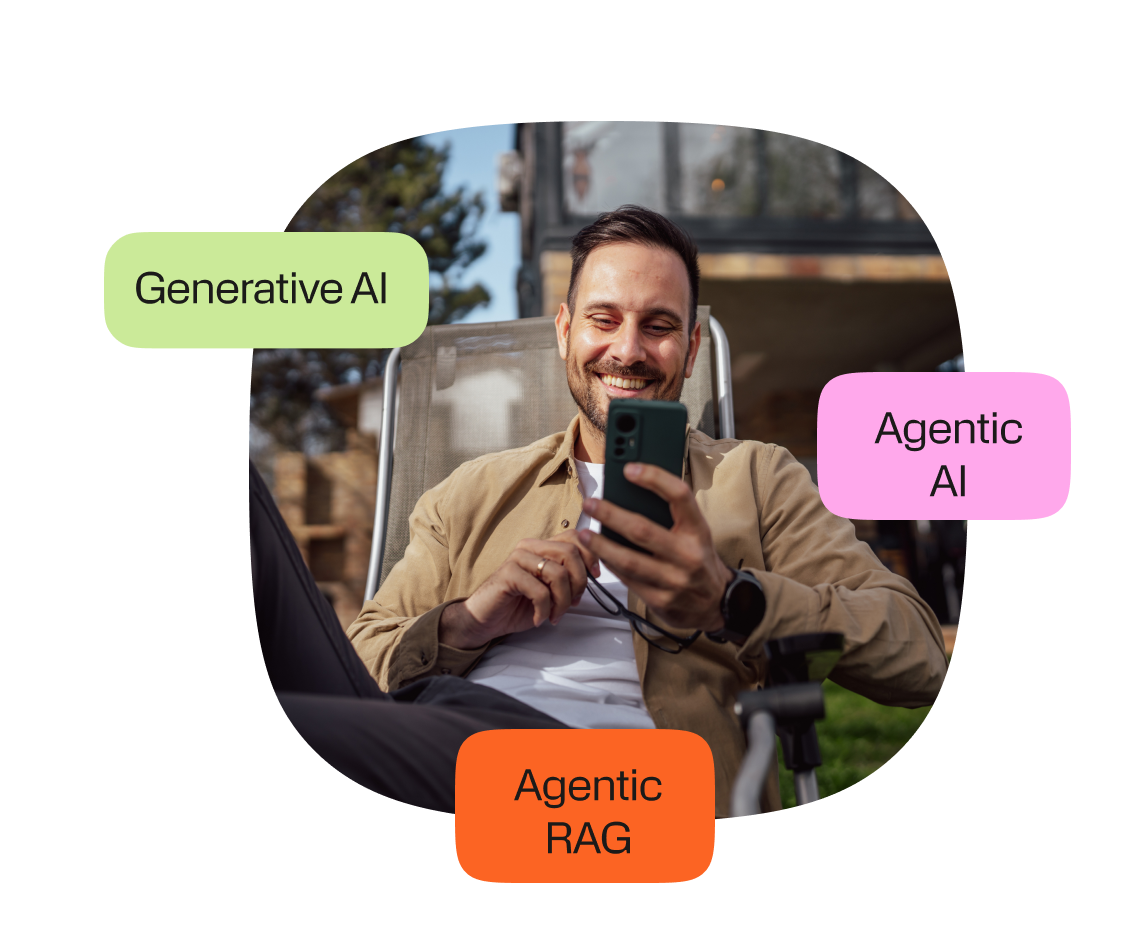
Customer service today can be powered by a new stack of more reliable AI capabilities. Generative AI, agentic AI, and agentic RAG each play an important role in ensuring customer service is convenient, accurate, and reliable. Let’s review the basics of each and why they are important:
Generative AI: Conversational engine
Generative AI produces natural, human-like language. It can understand questions, identify intents, and respond in a conversational way. Gen AI is what powers modern day customer support chatbots.
Why it’s important for customer service:
- Makes support feel human-like
- Handles complex intent and complex queries
- Can personalize responses to context and user history
- Allows for “just ask” customer service vs traditional scripted menus
What it can’t do: Generative AI can sound natural, but it can’t reliably verify facts or make decisions without additional layers.
Agentic AI: The decision maker
Agentic AI goes a bit further than just having conversations; it can actively make decisions, understand goals, and orchestrate workflows.
Examples of what agentic AI can do:
- Update account information
- Process a return
- Book appointments
- Run diagnostics
- Authenticate users
- Trigger workflows
Why it’s important for customer service:
- Goes beyond answering questions to solving problems
- Reduces the frequency of human intervention
- Ensures consistency and compliance
- Can understand when it can no longer help and transfer to an agent
What it can’t do: Agentic AI needs accurate information to be productive. Without grounding, its actions might be based on false or inaccurate information.
Agentic RAG: The fact checker
Agentic RAG is the integration of AI agents into retrieval-augmented generation (RAG). Basically, agentic RAG connects generative AI to knowledge bases (policy docs, products specs, CRMs etc.) and enables LLMs to collect information from multiple sources and remain accurate.
Why it matters:
- Eliminates hallucinations
- Ensures answers are compliant with regulations and policies
- Keeps AI aligned with up-to-date information
- Ensures the actions taken by agentic AI are grounded in accurate data
What it can’t do: While agentic RAG helps with accuracy, it needs generative AI for natural dialog and agentic AI to take action.
Putting it all together:
- Generative AI: Delivers natural, personalized conversations so customers get quick, clear responses.
- Agentic AI: Goes beyond chatting by handling tasks and taking action, like updating accounts or booking appointments, often without needing a human agent.
- Agentic RAG: Makes sure information is always accurate by connecting AI to up-to-date company knowledge, policies, and systems.
Together, these technologies turn simple chatbots into smart, reliable assistants that can answer questions, solve problems, and keep everything consistent, just what today’s customers want.

Top use cases for generative AI in customer service (2026)
Automated onboarding and training
Automated onboarding and training streamline how new customers or employees learn to use a product or service. Autonomous systems can handle tasks like setting up user accounts, adjusting preferences, or enrolling customers into programs. When these systems reference the most current documentation and compliance rules, onboarding processes stay accurate and up to date. This results in faster activation, higher engagement, and reduced support overhead.
Industries: SaaS, fintech, telecom, education, HR tech, healthcare, insurance, eLearning, B2B software
Real-time troubleshooting and tech support
Real-time troubleshooting uses AI to quickly diagnose and resolve technical issues. Generative AI chatbots understand complex errors and provide clear solutions, while agentic AI can automate checks, open tickets, or escalate cases. Agentic RAG grounds recommendations in verified guides, improving accuracy and reducing errors. This leads to faster problem resolution and better customer experiences.
Industries: Telecom, ISP, electronics, smart home services, automotive, IT services, SaaS, gaming, manufacturing equipment, energy and utilities
Guided product discovery
Guided product discovery helps customers find the right product, plan, or configuration through conversational interaction. AI analyzes preferences, context, and intent to recommend personalized options. Using rich messaging features like carousels and product cards, customers can easily browse options, compare details, and make selections. This engaging experience streamlines decision-making and boosts confidence, leading to higher conversions and satisfied customers.
Industries: Retail and eCommerce, telecom, travel, banking and insurance, automotive, real estate, electronics, B2B software
FAQ automation and knowledge base search
Automated FAQs have evolved; modern AI can now handle open-ended queries beyond pre-defined scripts. Agentic RAG finds accurate answers from trusted sources, cutting outdated replies and hallucinations. Agentic AI also supports actions like updating preferences, sending documents, or escalating issues, which lowers ticket volume and boosts consistency across customer service channels.
Industries: All industries, especially SaaS, government, healthcare, finance, telecom, retail, travel, insurance, higher education
Booking and managing appointments
AI makes booking appointments simple. Chatbots understand when and what time users want, while agentic AI checks calendars and books slots automatically. Agentic RAG ensures all appointment rules are followed, making the process faster and more accurate for customers.
Industries: Healthcare, wellness and beauty, automotive service, real estate, government services, banking, telecom, retail stores, hospitality, education
Account management
Account management includes updating personal information, resetting passwords, checking subscriptions, and modifying settings. With the latest developments in AI, customers can simply chat to request account changes, while the system securely manages updates and ensures everything stays accurate and safe behind the scenes.
Industries: Banking and fintech, insurance, SaaS, telecom, government, healthcare, subscription services, utilities, education platforms
Order tracking, delivery, and returns
AI makes it easy for customers to track orders, check delivery updates, and handle returns or exchanges. It can explain shipment details, update order statuses, and manage returns quickly and accurately by following company policies, making the whole process smoother for everyone.
Industries: Retail and eCommerce, logistics, food delivery, pharmaceuticals, telecom, automotive parts
Billing and payments
Billing and payments over messaging channels are made easy with the full AI stack. Customers can quickly check balances, pay bills, manage subscriptions, and handle disputes with clear explanations and step-by-step guidance. The combined power of generative AI, agentic AI, and agentic RAG keeps every transaction secure and compliant with all the latest rules.
Industries: Retail and eCommerce, banking, utilities, telecom, insurance, healthcare, subscription businesses
Multilingual support
Multilingual support enables global businesses to deliver customer service in any language or dialect. Generative AI excels at real-time translation, natural conversation, and cultural nuance, making support feel truly local. Customers can execute tasks in their native language, and the agentic RAG ensures that translated answers remain accurate to the source knowledge, reducing misinterpretation.
Industries: Retail, travel and hospitality, fintech, telecom, gaming, government, logistics, education
AI-powered agent assist
Even agents can benefit from this AI stack to help make their jobs faster and more efficient. The AI stack helps agents by quickly summarizing information, drafting responses, pulling up relevant data, and handling routine tasks. This speeds up support, improves accuracy, and makes agents’ jobs easier.
Industries: Contact centers, banking, healthcare, insurance, telecom, government, retail support teams, travel and hospitality, B2B service teams

Best practices for deploying AI-powered customer service
- Use agentic RAG to reduce hallucinations: Combining generative AI with trusted company data ensures answers stay accurate.
- Build hybrid human + AI workflows: Seamless handoff to human agents is essential for trust and customer satisfaction.
- Prioritize security and privacy: Ensure data governance is aligned with GDPR, CCPA, and industry regulations.
- Train on industry-specific data: Fine-tuning improves accuracy, reduces errors, and creates unique brand value.
- Monitor KPIs that matter: Resolution rate, human handover rate, accuracy and grounding, CSAT, time-to-resolution.
- Design for transparency and trust: Make it clear when customers are interacting with AI, and always offer a way to reach a human.
Challenges with implementing AI for customer service
While AI promises faster resolution times and more personalized support, implementing it effectively is far from simple. Many organizations still struggle with scattered, outdated knowledge sources that make accurate AI responses difficult. Agentic AI adds another layer of complexity: once AI agents begin updating accounts, processing payments, or modifying reservations, strict authentication, security controls, and compliance standards become essential. At the same time, deploying AI in isolated channels could lead to a fragmented customer journey if it’s not accounted for correctly.
Beyond the technology, organizations must also manage governance, data privacy, and ongoing maintenance. AI requires continuous monitoring, evaluation, and retraining as products, policies, and customer expectations evolve. And while automation can handle much of the workload, AI still needs thoughtful human oversight and well-designed escalation paths to maintain trust.
Without a cohesive strategy and the right orchestration layer, organizations risk delivering disjointed experiences, or worse, introducing operational and compliance risks. AI’s potential is enormous but unlocking it requires more than a chatbot; it requires unified systems, clean knowledge, and a mature deployment framework.
Future-proof your customer service with AI orchestration platform
Customer journeys today are multi-step and omnichannel requiring orchestration, not isolated chatbots. A modern AI orchestration platform connects conversations, actions, data, and automation into one cohesive engine, ensuring that every interaction feels seamless, accurate, and context aware.
Looking ahead, the future of customer service will be powered by even more advanced capabilities:
- Voice-enabled AI agents with natural, human-like prosody
- Proactive support that triggers automatically based on behavior, events, or intent
- Hyper-personalized journeys built from unified customer profiles and real-time context
- Fully autonomous, multi-step workflows managed by intelligent agentic systems
- Agent to agent solutions, where multiple AI agents collaborate, coordinate tasks, and resolve issues with minimal or no human intervention
These innovations won’t be delivered by standalone GenAI chatbots. They require a platform that can orchestrate data, actions, integrations, knowledge, and AI agents across the entire customer lifecycle. Infobip’s orchestration platform includes AI automation, cloud contact center, AI chatbot builders, and customer data platform that brings together all the data and integrations needed for successful customer support.